

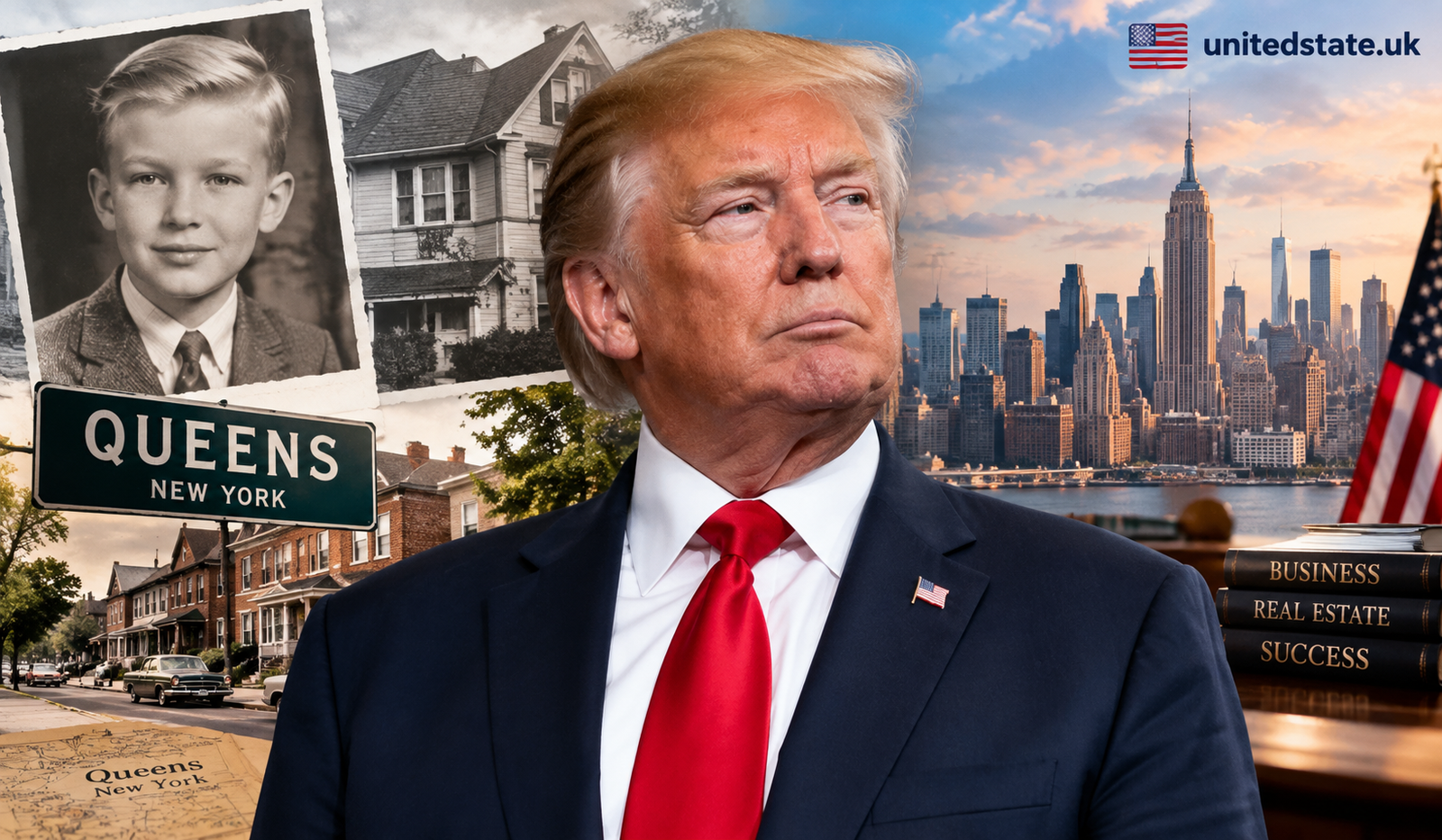
Few public figures have been written about as much as Donald Trump. He is a real estate developer, a television personality, and the 45th and 47th president of the United States. Yet the story of how he got there starts much earlier, in a middle-class neighborhood in New York City. Understanding Donald Trump’s early life helps explain the habits, relationships, and business instincts that followed him into adulthood.
This article covers his family background, his school years, his education, and his first steps in business, based on widely documented public record.
Donald Trump’s Early Life at a Glance
| Detail | Information |
|---|---|
| Full name | Donald John Trump |
| Born | June 14, 1946, Queens, New York City |
| Father | Fred Trump, real estate developer |
| Mother | Mary Anne MacLeod Trump, Scottish-born |
| Siblings | Maryanne, Fred Jr., Elizabeth, and Robert |
| Education | New York Military Academy, Fordham University, University of Pennsylvania (Wharton School) |
| Early career | Joined the family business in 1968 |
Family Background and Birth
Donald Trump was born in Queens, one of New York City’s five boroughs. He was the fourth of five children and grew up in Jamaica Estates, a comfortable residential neighborhood.
His Father, Fred Trump
Fred Trump built a large real estate business developing and managing apartment buildings, mainly in Brooklyn and Queens. The business gave the family a stable, affluent upbringing and later became the foundation of Donald’s own career. Fred was known for a hands-on, detail-oriented management style, and the younger Trump often spoke of his father as his main business influence.
His Mother, Mary Anne MacLeod Trump
Mary Anne MacLeod was born on the Isle of Lewis in Scotland and emigrated to the United States as a young woman. She raised the family in Queens and was active in charity work. Her Scottish roots later became part of the family story, including Donald Trump’s connection to Scotland through his golf properties there.
Growing Up in Jamaica Estates, Queens
Childhood in Jamaica Estates meant a large house, a busy household, and a father who regularly took his sons to construction sites and rent-collection rounds. Trump has said he learned early about buildings, contractors, and negotiation by watching his father work.
A few themes stand out from this period:
- Early exposure to real estate. Job sites were part of family life.
- A competitive household. With four siblings, the Trump home rewarded ambition and assertiveness.
- A strong work ethic emphasis. Fred Trump expected his children to be disciplined and focused.
Growing Up in Jamaica Estates, Queens
School Years: From Kew-Forest to Military Academy
Trump first attended the Kew-Forest School, a private school in Forest Hills, Queens. According to accounts from the family, his parents became concerned about his behavior and sent him at age 13 to the New York Military Academy in Cornwall-on-Hudson, New York.
What Military School Meant for Him
The academy emphasized structure, discipline, and competition. Trump excelled in athletics there, playing baseball, football, and soccer, and he held leadership roles in the cadet system before graduating in 1964. Many biographers see these years as formative for his competitive, results-driven outlook.
Higher Education: Fordham and Wharton
After military school, Trump enrolled at Fordham University in the Bronx and spent two years there. He then transferred to the Wharton School at the University of Pennsylvania, one of the best-known business schools in the country.
He graduated from Penn in 1968 with a bachelor’s degree in economics. Wharton gave him a business credential and connections in the world of finance and development, and it signaled that he planned to build on his father’s work rather than simply inherit it.
Entering the Family Business
Trump joined his father’s company, then known as Elizabeth Trump & Son, soon after graduating. In the early 1970s he took on a larger leadership role, and the company was later renamed The Trump Organization.
The First Major Projects
Two projects marked his move from Queens and Brooklyn into Manhattan:
- The Commodore Hotel renovation. Trump led the conversion of the aging hotel near Grand Central Terminal into the Grand Hyatt, which opened around 1980.
- Trump Tower. Completed in 1983 on Fifth Avenue, it became his signature property and a symbol of his brand.
These projects shifted his focus from outer-borough apartment buildings to high-profile luxury development in the heart of New York.
How Early Life Shaped the Public Figure
Looking at Donald Trump’s early life as a whole, several influences are commonly cited by biographers and journalists:
- Family business training: He learned the basics of real estate before he was an adult.
- Competitive environments: Both the household and the military academy rewarded winning.
- Brand awareness: His emphasis on the family name later became central to his business and political identity.
- New York roots: His outlook was shaped by the city’s construction, media, and deal-making culture.
Of course, interpretations differ. Supporters point to ambition and resilience, while critics emphasize the advantages of his family’s wealth. Both views draw on the same documented facts: a privileged start, a strong education, and a close tie to his father’s business.
From Real Estate to National Prominence
By the 1980s, Trump was a recognizable New York name. His profile grew further through books, media appearances, and later reality television. In 2016 he won the presidential election, and he returned to the White House after winning again in 2024, taking office in January 2025. For anyone researching how a developer from Queens reached that point, his early life is the natural starting place.
Tips for Researching Donald Trump’s Early Life
If you want to go deeper, here are practical ways to do it well:
- Use primary and reliable sources. Look for biographies, archival newspaper coverage, and university records.
- Compare multiple perspectives. Read both admiring and critical biographies to get a balanced view.
- Check dates and claims. Verify details such as school years and business milestones against more than one source.
- Separate documented facts from interpretation. Notice where authors are describing events and where they are characterizing them.
Frequently Asked Questions
When and where was Donald Trump born?
Donald Trump was born on June 14, 1946, in Queens, New York City.
Who were Donald Trump’s parents?
His father was Fred Trump, a New York real estate developer, and his mother was Mary Anne MacLeod Trump, who was born in Scotland.
Where did Donald Trump go to school?
He attended the Kew-Forest School, the New York Military Academy, Fordham University, and the Wharton School at the University of Pennsylvania.
What did Donald Trump study?
He earned a bachelor’s degree in economics from the University of Pennsylvania in 1968.
How did his early life influence his career?
Growing up around his father’s real estate business gave him early exposure to construction, management, and negotiation, which shaped his path into development.
What was Donald Trump’s first major business project?
Among his best-known early projects were the redevelopment of the Commodore Hotel into the Grand Hyatt and the construction of Trump Tower in Manhattan.
Conclusion
The story of Donald Trump begins in a Queens home shaped by a successful developer father, a Scottish-born mother, and a large, competitive family. His years at military school, Fordham, and Wharton prepared him for the family business, and projects like the Grand Hyatt and Trump Tower moved him onto a much larger stage. Whatever one thinks of his later career, studying Donald Trump’s early life gives useful context for the person who became one of the most discussed figures of his era.

